Source: ngto.org | Swamp Angel
The link below provides information regarding water conditions at the Medlock Bridge station near Norcross. It's about halfway between Abbotts Bridge and Jones Bridge.
Chattahoochee River at Medlock Bridge near Norcross, GA
The information at this particular location provides:
- Gauge Height in Feet
- Discharge Rate in Cubic Feet per Second
- E. Coli Count (An estimation of how much chicken poop is in the water at the moment)
- Precipitation in Inches (This will rapidly affect turbidity, and apparently has some effect on the chicken poop levels too)
- Specific Conductance (I don't know what the hell that means either, so I generally ignore this one)
- Water Temperature in Celsius (for those that can only understand base ten measurements)
- Water Temperature in Fahrenheit (for people who can put a man on the moon - unlike those other countries that have to use metric)
- Turbidity Levels in FNU's (They use a fancy term for how it's measured, but it's easy to read and figure out whether it's too muddy to fish)
Clicking on the little dot to the left of each of these parameters will adjust the chart at the top of the page and give you a pretty good idea of what's going on at the moment.
A Gauge Height of 2 feet is about as good as you'll ever get here. It means that the discharge is probably somewhere in the 1000 c.f.m. range, which is good for fishing from a canoe, 'yak, boat, or a float, or wading if you can find a place that affords some shoals. Being that this station is at Medlock Bridge, you can use this parameter, as well as the Discharge Rate, to make a fair assessment of whether the conditions will be good for wading downstream at Jones Bridge.
The Discharge Rate is best for wading when it indicates 3000 c.f.m. or less. Above 3000 c.f.m. it becomes harder to hold your place in the water and significantly harder to move. Flowing water is powerful, as most here probably already know.
The E. Coli estimate is something that I generally ignore. There aren't a lot of chicken farms lining the river between Buford Dam and Norcross. Just lots of subdivisions and pavement. A heavy rain will run off into the river quickly from the banks and from storm water drains, carrying oil film from the roads, trash dumped along the roadside by inconsiderate children of unwed parentage, and other undesirable and generally filthy things. I reckon E. Coli could be among these things, but I generally don't worry too much about it. The hordes of folks on innertubes during the summer between Abbotts Bridge And Medlock Bridge pollute the river a lot more than a few E. Coli colonies.
Precipitation is an afterthought for fishermen here since it is a record of what has already happened to cause the water to warm excessively during a summer thundershower, or to raise the turbidity to unfishable levels. It's like having a rear view mirror on a race car. I mean, come on! As my favorite Italian race car driver used to say, "What's-a behin' me is-a not-a important."
Specific Conductance. I have nary a cue what purpose this serves unless you're planning on using an old timey crank phone to shock up fish when they're not biting, so let's skip this one and move on...
Water temperature in Celsius isn't that important either. We're Americans. We use Freedom Units: inches, feet, miles, cups, gallons, yards, and even football fields as measurements. With our measuring system we put men on the moon! None of those people who use metric ever did that. So on to the next one...
Water temperature in Fahrenheit. When the temp is above 60 degrees at this location on the 'Hooch, it's probably because it has recently rained and the water is gonna be too muddy to fish anyway. In the winter months, the temps hold around the upper forties to low fifties with occasional dips into the low forties. The trout can still be caught, but they're gonna be sluggish. In the summers the water temps here are generally between 56 degrees and on rare occasion up to sixty degrees if it has been more than twenty-four hours since the last release from Buford Dam. This is just about right for both brownies and 'bows.
Turbidity! NOW we're talking! This is the meat and 'taters of all the information provided from this particular station. This tells you how clear the water is and whether the fish are going to be able to see your offerings with enough time to react to it and get a pierced lip. Turbidity readings between 0 and 9 are fishable.
A reading of 2 means that the water is plenty clear enough to see the bottom in about four feet of water, maybe even a little more. The fish will be able to see you every bit as well as you'll be able to see them when the reading is this low.
Turbidity levels of 4 or 5 are still pretty clear, but you're probably not going to be able to see the bottom. The trout, however, will be able to see your fly or spinner with plenty of time to react to it, and they more than likely won't be able to see you trying to tempt them to bite. This is the prime reading for me. I generally have a very successful day when the turbidity level is 4 or 5.
Turbidity levels of 6 to 7.5 are rather interesting. You can use larger flies without spooking fish and you might find yourself to be catching trout that are a tad bit bigger than the SNITs that are most usually caught. This is when the larger, wiser fish start feeling a little safer and begin moving. Very productive days can be had with the readings in this range. Maybe a little slower than what you'd expect if you were following the stocking truck, but you shouldn't lose interest due to a lack of action.
Turbidity from 8 to a tad over 9 is about the limit for fishing. Big fish can be found, but you'll have to search for them methodically. The water is going to be pretty murky at this point and larger flies or lures will be needed so the fish can see them. At the end of a drift, if you're fly fishing, it may prove to be more productive to slowly strip your fly back in before you re-cast. The trout can't see very far into the water around them and a slow moving fly passing nearby might just trigger a bite.
Turbidity of 10 and above is a lost cause. The Chattahoochee has turned into the Choco-hoochee at this point. It's the color of a cup of coffee with four teaspoons of sugar and a half a cup of milk poured into it. It's a brown, muddy, murky mess. There are those mentally unstable individuals who will fish the 'Hooch up to a turbidity of maybe a 14 or 15 in hopes of landing a state record brownie, but for most of us more sane individuals there's no point. Might as well stay at home and cut the grass, weed the flower beds, and get the grill fired up, 'cause the fish just aren't going to be biting for a while.
Now that we have all that out of the way, if you'll go back to that link and look down below all the data, you'll see a map with a bunch of red dots on it. Those aren't from chicken-pox or measles. Those are other data collection stations along the Chattahoochee and a few of the tributary creeks. Go ahead and click around on them. Check out the ones closer to the areas you intend to fish. I only selected the Medlock Bridge station because of the plethora of information available at that particular location.
Hopefully this will prove helpful to anyone who might be new to the Chattahoochee River tailwaters below Buford Dam. Releases from the dam can and will make the river from Buford Dam to Roswell extremely hazardous due to gauge heights and very high discharge rates, so before going out on the 'Hooch below the dam, call the Corps of Engineers for the release schedule at Buford Dam. The number is (770) 945-1455.
Source: ngto.org | Swamp Angel
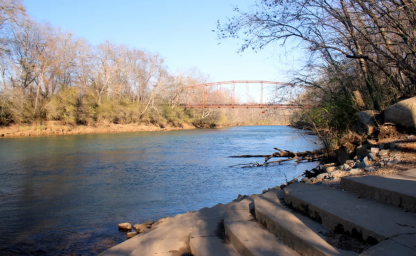
Chattahoochee Tailwaters
Posted on
10/25/2025 07:20AM
The Chattahoochee River tailwater refers to the section of the river immediately downstream from Buford Dam. This area is known for its excellent trout fishing, particularly during the delayed harvest season. The tailwater section is managed to maintain suitable conditions for trout, with a delayed...